Manufacturing Plant Roofing in Prescott Valley, AZ
Roof inspection, repair and replacement for manufacturing plants in Prescott Valley, AZ, with photo findings and shift-friendly scheduling.
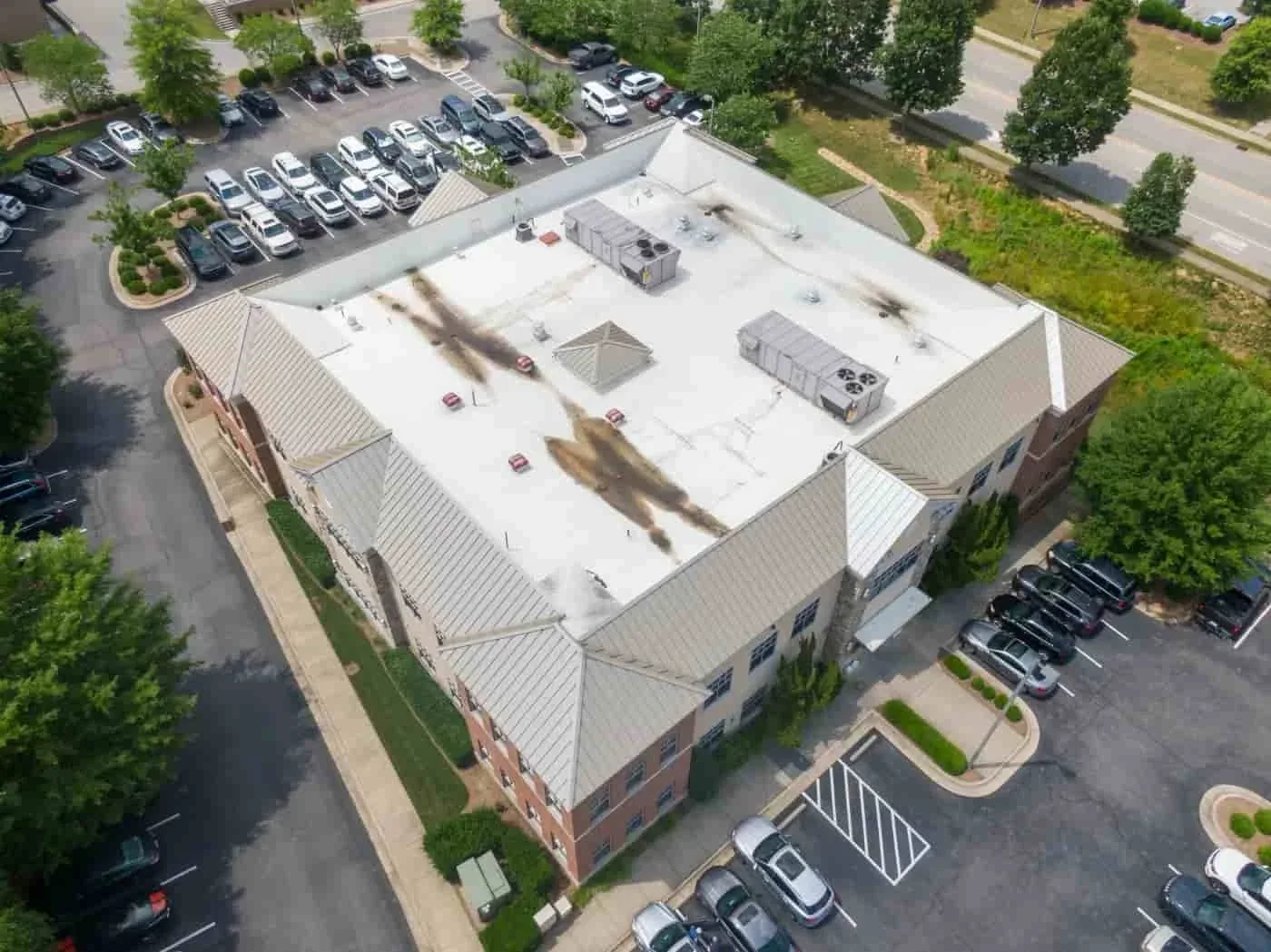
Start at the exhaust stacks. On a plant roof, the membrane near each stack tells the story. It is stained, softened or chalky where fumes and heat land on it. That is a finding with a cause. The roof is working as a vent field as well as a cover. In Prescott Valley, AZ, our walk covers every seam and every stack, with a photo for each. The written findings sheet reaches you before pricing starts, so you choose the order of work.
What a plant roof carries
A plant roof holds far more than a warehouse roof does. There are exhaust fans, make-up air units, dust collectors, piping runs and conduit. Each one has a curb or a support, and each curb has flashing.
Crews walk to these items every week. They carry tools, drag hoses and set down ladders. Over time the membrane wears along those routes. We mark the routes on the plan and recommend walkway pads where the wear is deep.
Skylights and smoke vents need the same look. Their curbs are tall, and their seals are old. A cracked seal lets in water every time it rains. We photograph each one.
What the local plants tell us
MI Windows and Doors has 440 employees in Prescott Valley. Superior Industries has 150. Both appear among the manufacturers on the east side near the Fain Road corridor. The Prescott Valley Economic Development Foundation targets aerospace, manufacturing and medical companies of roughly 10 to 125 employees.
If a plant has grown in wings, each wing can carry a different roof system. So we write one findings sheet per roof area and not one for the whole site.
The same habit helps with budgets. A plant manager can see which wing needs money this year. A finance lead can see which wing can wait. Nobody has to guess from a single average. A neighboring distribution center on the same road may sit in a similar spot, but its roof will not be identical.
Why fumes and heat matter
Exhaust can carry oil mist, solvent vapor or fine dust. Some of it settles on the membrane. Some single-ply membranes swell or soften under oil. Others hold dust that bakes in the sun.
We check the surface near each stack by pressing it. Soft spots mean the chemistry is working on it. A PVC roof resists many oils and fats better than other single-ply types. We name the product that fits the exhaust, and we write down why.
Grease and oil also eat sealant. Look at the bead around each curb. If it is soft, it is failing. We cut it out and reseal with a product that tolerates the exhaust. A bead that failed once will fail again if the same sealant goes back.
What monsoon and freeze do to a plant
Monsoon cells bring gust fronts, heavy rain and hail in stones from pea-sized to half-inch. The July 20, 2026 cell that crossed Prescott Valley toppled traffic signals and trees. A plant has many roof penetrations, and every one is a place for water to enter.
Then comes the freeze. The freeze season opens in late October and closes around the start of May, and a daily swing near 30 degrees works every flashing. We check curbs after storms and again before winter. A failed curb is a flashing failure, and we price each one by itself.
Snow adds weight on top of that. Snow averages about 10 inches a season in Prescott, and a drift against a tall wall can load a low roof. We check drain paths so melt can leave the roof before the next freeze.
How production schedules shape the work
Production lines run in shifts, and a shutdown can cost more than a repair. So we plan around the production calendar.
We ask three questions. Which lines cannot take water at all? Which exhaust fans can be shut down, and for how long? When is the plant quietest? Then we sequence the work to protect the sensitive lines first. The maintenance lead gets the dates in writing, with a reminder two days out. This is the same method used in occupied building reroofing, with a tighter look at shutdown windows.
What to repair now and what can wait
Repair now: leaks over live equipment, failed curb flashing, open seams and blocked drains. These let water in. A stained ceiling over a machine is a reason to act this week.
The sheet gives every item a photo, a place on the plan and a price. Because the lists stay apart, no line hides in a lump sum, and the first list can be funded now while the rest is scheduled.
What can wait: surface chalking, light staining and dirt away from stacks. We list them with photographs so you can plan next year's budget. For roofs with unknown moisture, an infrared moisture survey maps the wet areas first. A warehouse roof at the same site can follow the same schedule.
Commercial Roofing Questions
Can a manufacturing plant keep running during a reroof?
Yes, in most cases. The crew works one section at a time and closes each before shift end. We cover fresh-air intakes and exhaust, and we plan fan shutdowns with your maintenance lead. The roof is dried in each night, and the crew sweeps the area so debris does not blow into open bays. For sensitive lines, we add protection below the work zone and set quiet hours. Send us the shift calendar and we build around it. We also ask which walls and bays share a roof with a neighboring tenant, so the plan stays inside your boundary.
How do we choose a membrane for a plant with oily exhaust?
Match the membrane to the exhaust. PVC resists many oils and fats, so it is often the choice near stacks. TPO and EPDM suit the rest of a clean field. We take a surface sample near each stack and note the product in the findings sheet. The sheet also lists the sealant at each curb, since the sealant is often the first thing the exhaust attacks. If the exhaust is aggressive, we recommend a detail with a drip pan or a different membrane in that zone.
What should be in a roof file for an insurer?
One folder should hold dated photographs, the findings sheet, repair invoices and warranty papers, plus a plan marking each penetration. An insurer wants proof of condition before a loss. We update the file after every storm, so the record shows what changed and when. A lender or a buyer reads the same file, and a clean record shortens their questions.
How soon after hail should we call?
Call within a week. Stones from pea-sized to half-inch can bruise a membrane without making a hole. Bruises fade and weather over, so a dated photo set taken soon after the storm helps a claim. We press on suspect areas and mark each one on the plan.
Is a coating a good option for a plant roof?
It can be, if the insulation is dry and the membrane is sound. A coating lowers surface temperature and seals small defects. It does not fix wet insulation. We run a moisture scan and cut a few cores first, then give you a price for a coating and a price for replacement. Coatings are applied in mild, dry weather, so the booking window is late spring through early fall.
Request a walk-through
Ask for a walk-through of your plant roof. We send a written findings sheet with photos before we price any repair. You decide what to fix now and what can wait.
Request a Roof Assessment
Commercial Roofing Questions
Yes, in most cases. The crew works one section at a time and closes each before shift end. We cover fresh-air intakes and exhaust, and we plan fan shutdowns with your maintenance lead. The roof is dried in each night, and the crew sweeps the area so debris does not blow into open bays. For sensitive lines, we add protection below the work zone and set quiet hours. Send us the shift calendar and we build around it. We also ask which walls and bays share a roof with a neighboring tenant, so the plan stays inside your boundary.
Match the membrane to the exhaust. PVC resists many oils and fats, so it is often the choice near stacks. TPO and EPDM suit the rest of a clean field. We take a surface sample near each stack and note the product in the findings sheet. The sheet also lists the sealant at each curb, since the sealant is often the first thing the exhaust attacks. If the exhaust is aggressive, we recommend a detail with a drip pan or a different membrane in that zone.
One folder should hold dated photographs, the findings sheet, repair invoices and warranty papers, plus a plan marking each penetration. An insurer wants proof of condition before a loss. We update the file after every storm, so the record shows what changed and when. A lender or a buyer reads the same file, and a clean record shortens their questions.
Call within a week. Stones from pea-sized to half-inch can bruise a membrane without making a hole. Bruises fade and weather over, so a dated photo set taken soon after the storm helps a claim. We press on suspect areas and mark each one on the plan.
It can be, if the insulation is dry and the membrane is sound. A coating lowers surface temperature and seals small defects. It does not fix wet insulation. We run a moisture scan and cut a few cores first, then give you a price for a coating and a price for replacement. Coatings are applied in mild, dry weather, so the booking window is late spring through early fall.