Senior Living Roofing in Prescott Valley, AZ
Roof inspections, leak repair and replacement for Prescott Valley, AZ senior living communities, planned around residents, care schedules and monsoon weather.
Start with the corridor ceiling tile that has a tan ring on it. On a senior living roof, that ring is a clue, not an answer. Water runs along the deck before it drops. A resident then sees a drip near a bed or a walker path. That is a safety problem before it is a roofing problem. We walk the roof in Prescott Valley, AZ, trace the ring back to its source, and photograph every finding. You get a written sheet before anyone prices a repair.
Many retirees live in this town. The buildings that house them need roofs that stay quiet, dry and predictable.
What we find
A senior living roof can be a patchwork. A community may have a main building, a memory care wing, a dining hall and a row of attached cottages. Each section may have been added at a different time. Each section may carry a different roof.
The joints between sections are the weak spot. A step in the roofline, a wall where two roofs meet, a short parapet. Each one needs flashing, and flashing ages. We probe those joints first. Then we check the drains, because a wing that sheds water onto a lower roof sends it all to one drain.
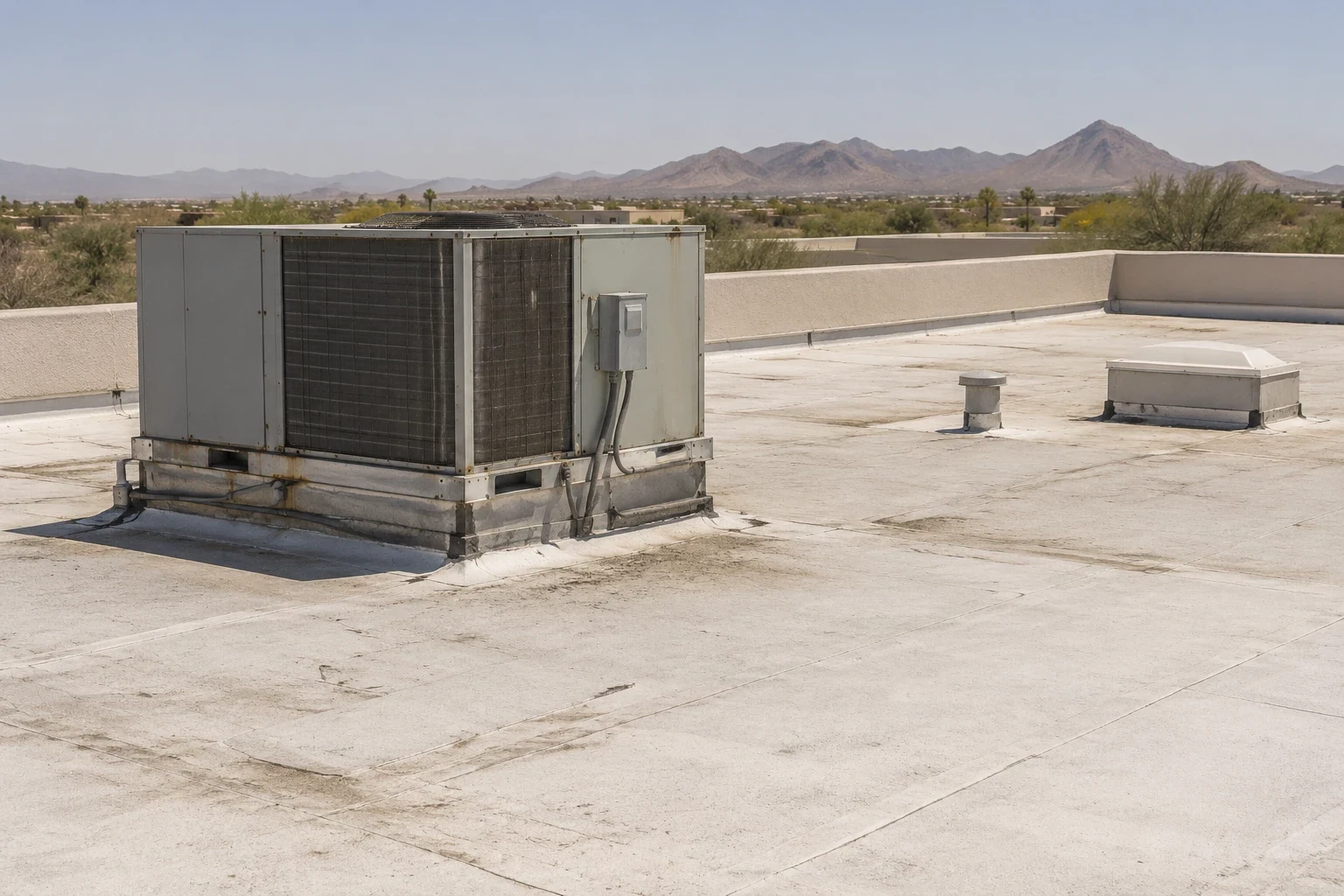
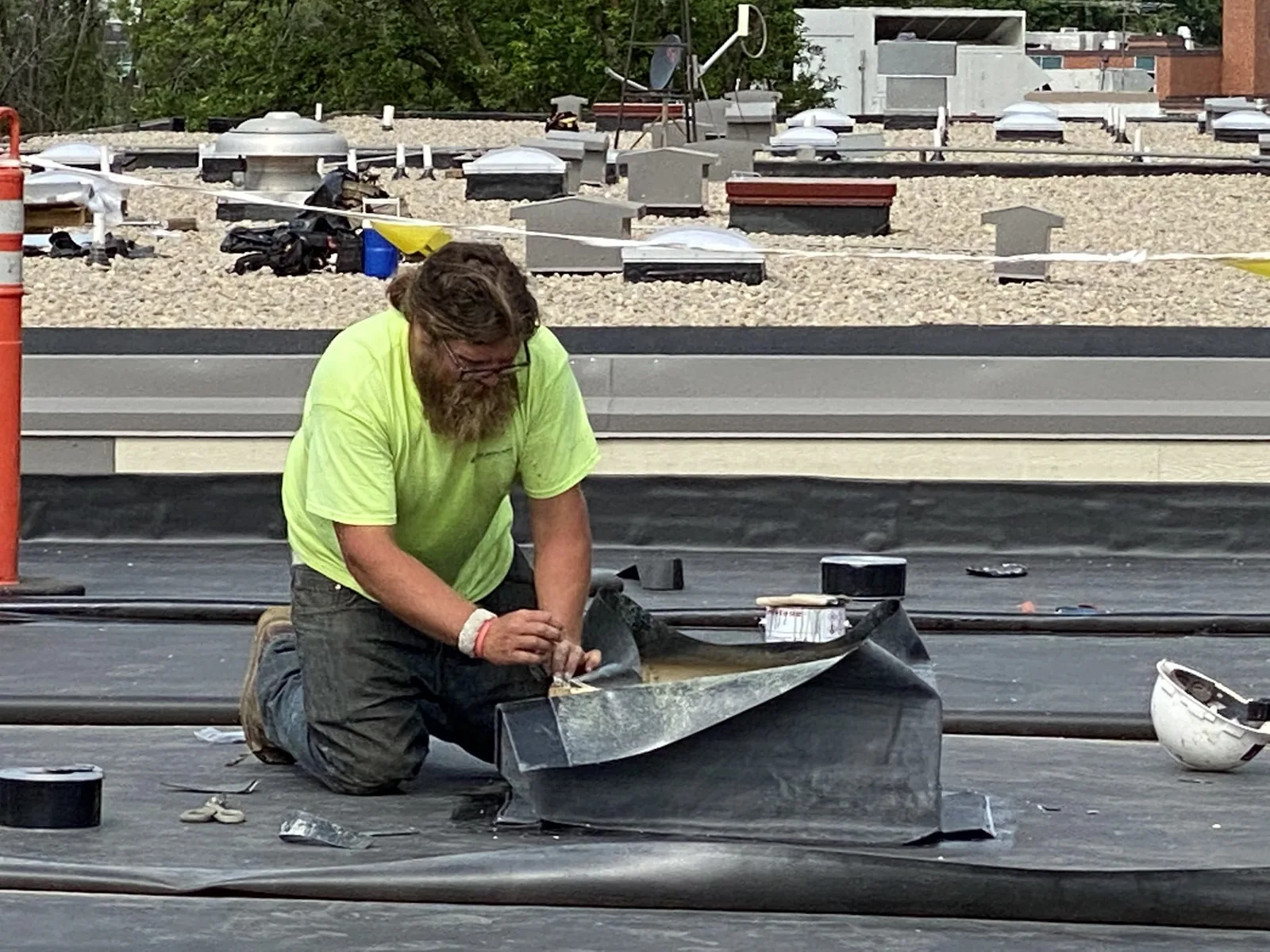
We also look at what sits on the roof. Kitchen exhaust, boiler stacks and rooftop air units each have a curb. Each curb has a seal. Those seals work loose over time, especially when a technician steps on them.
Some care campuses adjoin medical space, and Yavapai Regional Medical Center East Campus is one of the town's largest employers. Where a community shares a wall with a clinic, the medical office roof gets the same walk and the same sheet, since a leak at a shared wall can reach the next building.
What monsoon and freeze do
The precipitation total in Prescott Valley is about 15 inches a year, and most of it falls in July and August. One cell can bring rain, wind and pea-sized hail in ten minutes, and the July 20, 2026 storm put signals and trees on the ground across town.
Winter does a different kind of harm. Freezing temperatures set in around late October and last into the first days of May. Water that gets into a seam on a warm afternoon freezes by morning. It expands. The seam opens a hair more each cycle. Daily temperature swings near thirty degrees keep that cycle going.
A resident building cannot afford a slow leak that shows up in February. So we look at seams and flashings in the fall. We want to find the open edge before the first hard freeze finds it for us.
How work happens around residents
A senior living community never closes. Residents nap, take medication on schedule and move slowly through halls. A roofing crew has to fit around all of that. Our plan for occupied building reroofing starts with a talk with the director of care. We learn quiet hours, meal times and which rooms have residents who are sensitive to noise.
We then work in small sections. We open only what we can close the same day. Debris chutes stay away from entries and walking paths. Material goes up and comes down when the courtyard is empty. Fumes from adhesives are managed by timing the work and choosing products with low odor where the system allows.
We post notices for families and staff. A clear schedule prevents worry. It also prevents complaints from visitors who do not know why there are workers overhead.
What to repair now, and what can wait
Some findings cannot wait. An open seam over a resident room. A cracked pipe boot above a care station. A drain screen packed with gravel before monsoon season. Those get priced first, and they get a date.
Other findings can wait a season or two. Surface wear on a sound membrane. A sealant bead that is dry but still bonded. A minor ponding line that clears in a day. We list those with a note on what to watch.
The split matters for the budget. A community that manages a campus, or a group of campuses, can plan preventive maintenance for the second list. That keeps the first list short. It also gives the administrator a clear answer when an owner asks why the roof line moved. Where a leak is already active, our leak repair work starts with finding the entry point and not with covering the stain.
What to ask for in writing
Ask for a findings sheet with photos. Ask that each finding has a location on a roof plan. Ask for a price on each item, split into repair now and repair later. Ask what the work does to the warranty, if one exists.
Ask for the schedule, too. Senior living is different from a retail strip. You cannot move residents out for a week. The written plan should say which sections are open on which days, and what happens if a monsoon cell blows in.
A community near the Entertainment District or along State Route 69 deals with busy roads and event traffic. Ask where the crew will park and where deliveries will enter. A good plan answers that before the first truck arrives. Communities that mix independent living with apartment-style buildings should ask whether one scope can cover both roof types.
Last, ask how the report treats the older sections. A hospital-style wing may call for the tighter dust and air-intake control a hospital roof job uses. A cottage row does not need that. A plan that treats them the same will cost more or protect less.
Commercial Roofing Questions
How do you protect residents from noise during a reroof?
We schedule the loudest steps, such as tear-off and fastening, for mid-morning and early afternoon, and we avoid nap and meal times where possible. The director of care reviews the plan and tells us which wings are most sensitive. For memory care, we may move work to the far side of the building first and keep a staff member on site as a contact.
Can a senior living roof be inspected without disturbing anyone?
Yes. Most of the walk happens outside, on the roof itself. We come inside only if a stain needs to be traced, and then we ask for a staff escort and keep the visit short. Drone photos can cover large roofs quickly and keep the crew off the surface while it is wet or icy.
What should we do about a stain over a resident room?
Take a photo, note the date, and move any furniture or belongings out of the drip path. Then send us the room number and the roof wing. We trace the stain by walking the roof above it, checking drains, flashing and penetrations. A temporary dry-in can go on within hours if the leak is active, and the permanent repair is priced after we see the cause.
Do cottages and attached units need separate scopes?
Often they do. Cottages can have smaller roofs, lower pitches and shared walls, while a main building can carry a larger low-slope section. We write one report for the campus and price each building on its own line, so the owner can phase the work.
Will winter stop a repair?
Not always. Small repairs can go on in cold, dry weather with the right materials. Large work waits for steady temperatures above freezing in the morning. We plan the big items for late spring or early fall and use winter for inspection and temporary repairs.
Request a walk-through
Ask for a walk-through of your senior living roof. We will send a written findings sheet with photos before we price any repair, and we will plan the work around your residents and care schedule.
Request a Roof Assessment
Commercial Roofing Questions
We schedule the loudest steps, such as tear-off and fastening, for mid-morning and early afternoon, and we avoid nap and meal times where possible. The director of care reviews the plan and tells us which wings are most sensitive. For memory care, we may move work to the far side of the building first and keep a staff member on site as a contact.
Yes. Most of the walk happens outside, on the roof itself. We come inside only if a stain needs to be traced, and then we ask for a staff escort and keep the visit short. Drone photos can cover large roofs quickly and keep the crew off the surface while it is wet or icy.
Take a photo, note the date, and move any furniture or belongings out of the drip path. Then send us the room number and the roof wing. We trace the stain by walking the roof above it, checking drains, flashing and penetrations. A temporary dry-in can go on within hours if the leak is active, and the permanent repair is priced after we see the cause.
Often they do. Cottages can have smaller roofs, lower pitches and shared walls, while a main building can carry a larger low-slope section. We write one report for the campus and price each building on its own line, so the owner can phase the work.
Not always. Small repairs can go on in cold, dry weather with the right materials. Large work waits for steady temperatures above freezing in the morning. We plan the big items for late spring or early fall and use winter for inspection and temporary repairs.