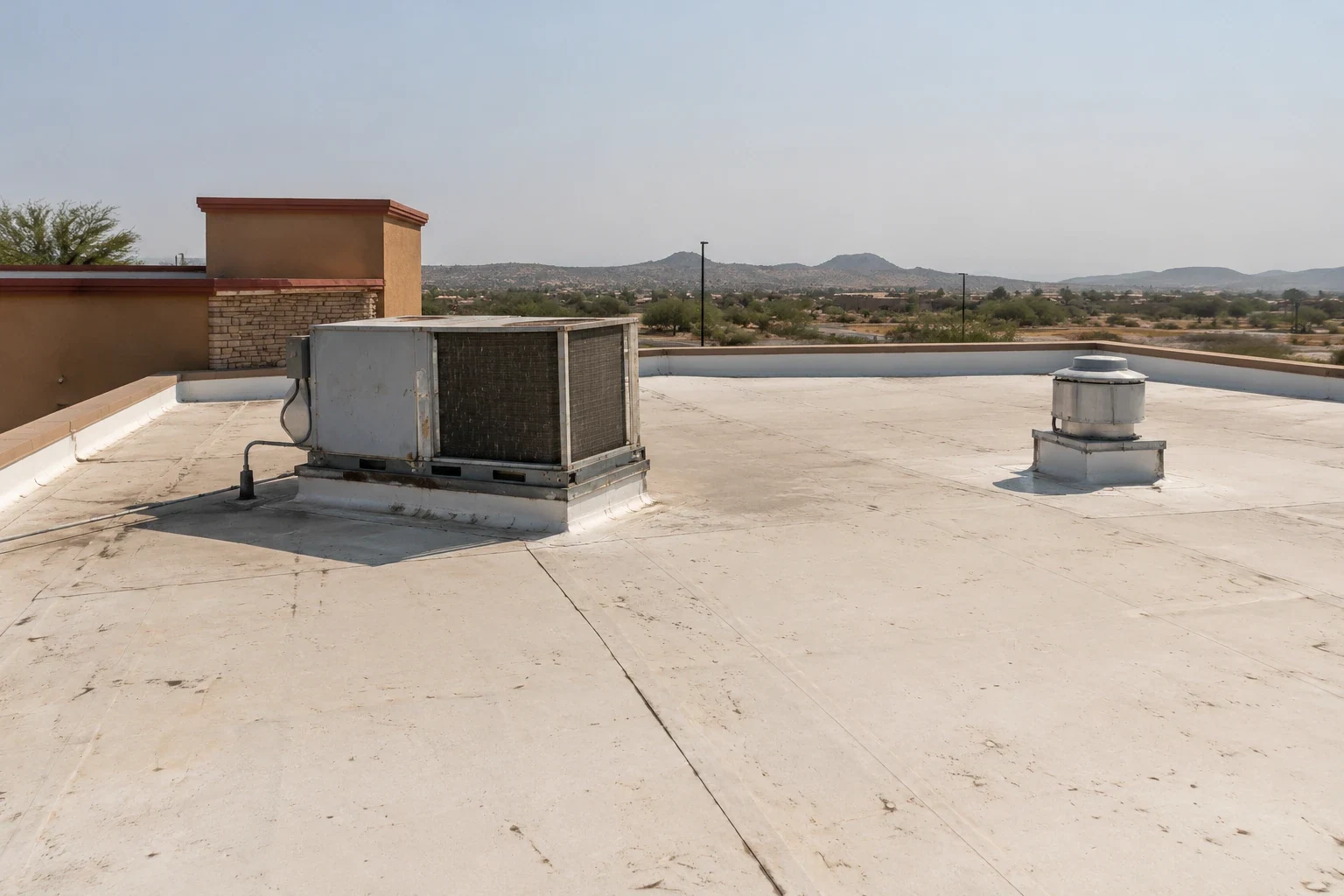
Commercial Roofing in Village of Oak Creek, AZ
Commercial roof inspection, repair and replacement in Village of Oak Creek, AZ for tourism, service and retail buildings, with seasonal scheduling.
Check the gutters and the scuppers on the downhill side. In Village of Oak Creek, AZ, water arrives hard and leaves fast, and a roof that cannot pass it becomes a pond within minutes. The community had 6,128 residents in 2020 at 4,105 feet, and its economy rests on tourism and services for retirees and second-home owners. Commercial roofs here get a probe along every seam and a photograph of each finding, and the written sheet reaches the owner ahead of any price.
Flash floods, hail and wind
Monsoon thunderstorms in this community bring flash floods and occasional hail, and winds in storms can top 50 mph. A roof meets all three. Water arrives faster than a drain was sized for. Hail bruises soft membranes. Wind finds any edge that is not tight.
The checks follow the three. Drains and scuppers are traced from the high point, with the screen, the bowl and the pipe below. Hail marks are pressed and photographed, and a core is cut where a mark looks deep. Edge metal, cleats and fastener rows get a tug test. A roof that handles all three has clear outlets, a firm surface and a tight perimeter.
Flash floods add one more question. Water at ground level can reach a building's base while the roof stays dry, which is why the post-storm report keeps roof findings and ground-level findings on separate lines, and the sheet notes which damage came from above and which did not, so a claim lands with the right party.
Tourist buildings and absent owners
Tourism and second-home ownership shape the building stock. Shops, galleries, lodging and food service serve visitors, and some owners are not on site most weeks. A leak that starts while the owner is away runs longer and costs more than one noticed the same day.
That changes the maintenance plan. A seasonal walk, spring and fall, with dated photographs, replaces the owner's eyes. After any storm that brings hail or heavy rain, a quick check of drains and ceilings goes on the list for whoever holds the keys. The photographs travel to the owner by email, so a manager far away sees what the roof looks like. A roof that has been photographed every spring and fall builds a record that helps with insurance, with a sale and with the next repair decision.
Lodging and galleries often have decorative parapets and small roof decks. A deck with furniture sends foot traffic across the sheet, so walk pads and a drain check come first. A parapet with a decorative cap is checked for loose joints, since a joint that opens in a freeze lets water run behind the wall.
Restaurants and food service bring kitchen exhaust. Grease softens many membranes and holds dust, so the sheet around each fan is pressed, a drip tray is added where one is missing and a cleaning interval goes on the sheet. A restaurant roof carries the same logic anywhere.
A little snow, a quick melt
Snow averages about 5 inches a year and usually melts within a day. That sounds harmless, and it mostly is. The trouble is the melt: water runs to the same low points every time and refreezes at a scupper on the cold nights that follow. Ice in a downspout can split a joint.
An autumn pass clears outlets, resets hangers and tightens gutter joints, so the first cold snap finds a roof that can drain. Daily temperature swings work seams and flashings regardless of snow, and a sheet that was tight in October may show a gap by February.
What the walk covers
The walk starts at the edges, then the flashings, then the field. On a roof with a hatch, the key holder is named in advance so no one waits on the sidewalk, and a roof without a hatch gets a ladder plan that does not cross a shop entrance. Every seam is probed with a blunt tool. Every penetration is photographed. Equipment curbs get a press test, and the sealant is checked for softness. The sheet lists each finding with a number, a photograph and a rank, and it records the roof type found, not the type expected.
An infrared moisture survey helps when a stain suggests water inside the insulation. The scan shows warm patches at dusk, and cores confirm them. The result outlines the wet zone, so the owner sees whether a section repair or a larger scope is the answer.
Repair, coat or replace
Sorting happens by condition. Where the base is dry and the surface is worn, a coating lowers surface heat and seals small cracks. Where a few details have failed, repair is enough. Where insulation is soaked, replacement is the answer. Cost follows roof area, insulation condition and penetration count.
Timing in a tourist town follows the visitor calendar. Busy weekends and holidays are avoided where possible, and work over an entrance happens when no one is under it. A planned commercial roof repair groups drains, seams and flashings into a single trip, which suits a small building with an owner who is not nearby. A distant owner also benefits from one clear point of contact, so questions about access, keys and tenants go to a single person.
Tenants matter as much as owners. A gallery or a shop with stock near the ceiling needs to know when the crew will be overhead, and what is covered. Notices go out a week ahead, with the dates, the hours and a name to call, and the entrance plan is posted at the door.
Reaching the village
The village lies in the Verde Valley, and crews reach it from the Cottonwood side. Cornville and Cottonwood sit along the same route, so an owner with property in more than one place can ask for a single trip. A leak in progress is handled as emergency roof repair before any scheduled work.
Commercial Roofing Questions
What should a second-home owner do about the roof?
Schedule a spring and a fall walk with dated photographs, and give a neighbor or manager a short list to check after storms. The photographs reach the owner by email, so the roof is watched even when the building is empty.
Does hail matter on a low-slope roof?
It can. Hail bruises soft membranes, and a bruise may leak weeks later. After a storm the surface is pressed, soft spots are marked and a core is cut where a mark looks deep.
How does a flash flood affect a roof?
The roof usually stays dry while the ground takes the water, but the drains still face a rush of rain. Outlets are traced before the season so they can pass a heavy cell, and the sheet notes which damage came from above.
Can a restaurant roof near a kitchen be protected?
Yes. A drip tray under the discharge, a grease-resistant detail around the fan and a cleaning interval protect the sheet. The area around each fan is pressed for softness at every visit.
How fast can a leak be stopped in the village?
Emergency calls are taken day and night. A crew sets a temporary dry-in the same day when access allows, and the permanent scope follows once the cause is clear. The owner receives dated photographs of the opening before and after, whether or not the owner is in town, along with a short note on how long the temporary fix should hold.
Request a walk-through
Ask for a roof walk in Village of Oak Creek. Send the roof age, any leak history and your busy and quiet weeks. You receive a written findings sheet with photos before any repair is priced.
Request a Roof Assessment
Commercial Roofing Questions
Schedule a spring and a fall walk with dated photographs, and give a neighbor or manager a short list to check after storms. The photographs reach the owner by email, so the roof is watched even when the building is empty.
It can. Hail bruises soft membranes, and a bruise may leak weeks later. After a storm the surface is pressed, soft spots are marked and a core is cut where a mark looks deep.
The roof usually stays dry while the ground takes the water, but the drains still face a rush of rain. Outlets are traced before the season so they can pass a heavy cell, and the sheet notes which damage came from above.
Yes. A drip tray under the discharge, a grease-resistant detail around the fan and a cleaning interval protect the sheet. The area around each fan is pressed for softness at every visit.
Emergency calls are taken day and night. A crew sets a temporary dry-in the same day when access allows, and the permanent scope follows once the cause is clear. The owner receives dated photographs of the opening before and after, whether or not the owner is in town, along with a short note on how long the temporary fix should hold.